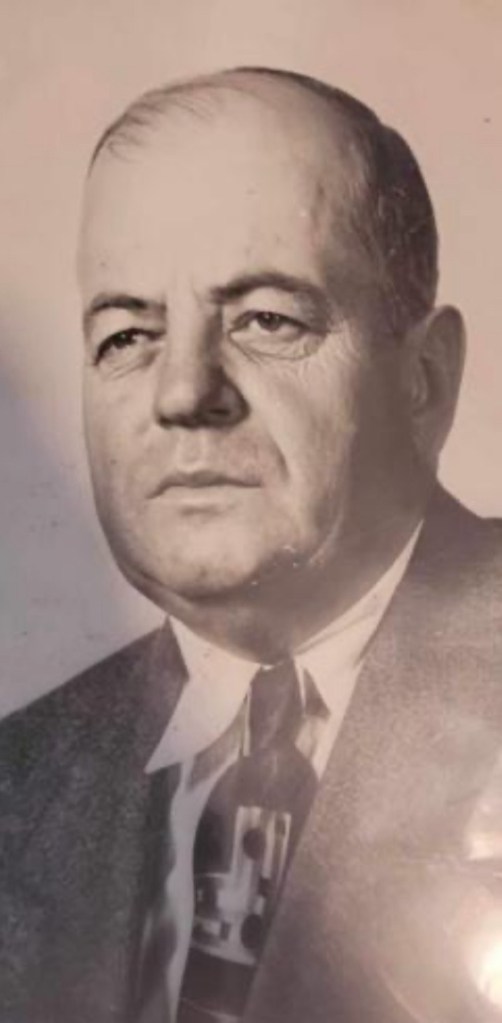
Editor’s note: The following is Part 1 of “The Saga of Harold Congdon”.
Civilizations aren’t solely constructed by the virtuous, nor do laws benefit only the innocent. On March 4, 1919, the 66th United States Congress convened in a historical moment as the last congress without female members in the House of Representatives. Dominated by a Republican majority and the final years of Democratic President Woodrow Wilson’s term, this era was pivotal in introducing women’s suffrage and the 18th Amendment, initiating the Prohibition era. In Salisbury, at the age of 26 Harold Congdon, an emerging Republican figure, rose to prominence. His election as selectman and eventual promotion to police chief marked a transformative period in both his personal journey and the town’s destiny.
On Jan. 15, 1920, an arsonist set fire to the popular marathon dance pavilion The Ocean Echo. Two days later, the Volstead Act went into effect. Strategically situated along the Gulf of Maine, Salisbury became a prime location for the secret alcohol trade, benefiting from proximity to Canadian rum runners from New Brunswick. Despite Congdon’s hard stance on illegal consumption and vocal support for prohibition and women’s suffrage, he ironically led a covert operation, exploiting Salisbury’s position. His dual roles, including “overseer of the poor” allowed him to wield welfare distribution to consolidate his political sway and secure steadfast town loyalty.
As the Commander of the Newburyport Coast Guard looked the other way, the rum running speed boat “Pet 2” chartered through the mouth of the Merrimack River, around the Toothpick, and then up Black River Creek, leading to a dock where a pivotal hub for this illicit trade emerged. In a time when cars were scarce, Harold Congdon’s three-door touring Model T was crucial for both town service and his illicit activities. Here, illegal liquor was unloaded and transported to distribution centers in south-end cottages, local hotel speakeasies like the Central House, and Venetian Gardens at the beach, and occasionally even the local Methodist church. The entire town seemed entangled in this underground enterprise.
The Volstead Act led to the appointment of 1,500 Prohibition agents. Among them, Agent Henry Weever from Maine identified Salisbury as a major point of entry, and a vital alcohol sanctuary and distribution center for the Merrimack Valley. His team’s sting operation and subsequent raid on Jan. 23, 1924, at the Davis cottage on the beach’s south end, culminated in a dramatic shootout where a federal officer was saved by a quart of Canadian whiskey that fragmented the projectile sending pieces into the agents pocket. This raid unveiled a network involving Salisbury businessmen, local officers, and Harold Congdon himself, not just as the ring leader but also as a protector for local establishments, gangsters, and dealers who paid the Salisbury police $50 a week for protection.
Sarah Congdon, Harold’s wife, played a crucial role in the rum-running operations, with her strategic awareness and intense jealousy driving her deep involvement. Despite suspicions of Harold’s fidelity since their 1914 marriage, Sarah’s indispensable role contrasted with her own affairs, indicating that loyalty wasn’t the foundation of their union. Sarah’s diary of daily transactions and her testimony against Harold’s accomplices, like Anthony Caramango, a connected guy, who said “she squealed on everybody” proved pivotal.
Under the police chief’s leadership, the Salisbury gang, including Harold’s closely named identical twin brother Harry E. Congdon, hotel proprietor Dennis Kelleher, local police, selectmen, city councilors from Newburyport, and Coast Guard Commander Harry F. Burnham, flourished in the early Prohibition years. Yet, internal greed, power struggles, and increased federal attention led to dramatic confrontations, culminating on Jan. 24, 1924, with numerous indictments and major trials exposing widespread corruption.
Despite the scandal and a four-month jail term, Congdon’s influence persisted. His continued political involvement and the sensational incidents further tarnished his reputation, yet his local popularity with a vision for Salisbury as a tourist destination continued. His influence spurred the construction of Bridge Road, expanding Route 1, the widening and installation of sidewalks on Beach Road., and a brand new police station with public bathrooms on Railroad Avenue, enhancing access and attracting more visitors. Salisbury, for the first time since losing the industrial part of town to Amesbury 36 years prior, was booming, becoming a hotspot not just for family activities, dance marathons, and amusements but also for illegal gambling, prostitution, and alcohol tourism.
The town’s evolution into an illegal liquor hub and the subsequent crackdown reflected the nation’s conflicting stance on prohibition, morality, and governance. Harold’s story, marked by ascent and descent, painted him as a figure of immense power with a complex legacy. Following his 1924 indictment, he stepped down as chief and selectman, yet managed to secure a narrow victory in the 1925 town election even while undergoing trial. After a stint in Plymouth County Jail, strategically situated 82 miles away to prevent local friction, Harold swiftly reclaimed his position as police chief.
His story, and the tumultuous relationship with Sarah, were far from concluded. The town’s transformation and legal battles were merely the prelude to a saga of ambition, scandal, and power struggles, setting the stage for more intricate tales of human relationships, schemes, trials, and the quest for control in the thriving resort town of Salisbury Beach.
Salisbury resident C.J. Fitzwater is a curious traveler, perpetually on the lookout for fresh frontiers. With each journey, he blends historical threads into his stories.
 Curious Traveler
Leave a comment