Curious Traveler: CJ Fitzwater
Editor’s note: The following is Part 2 of “The Saga of Harold Congdon”.
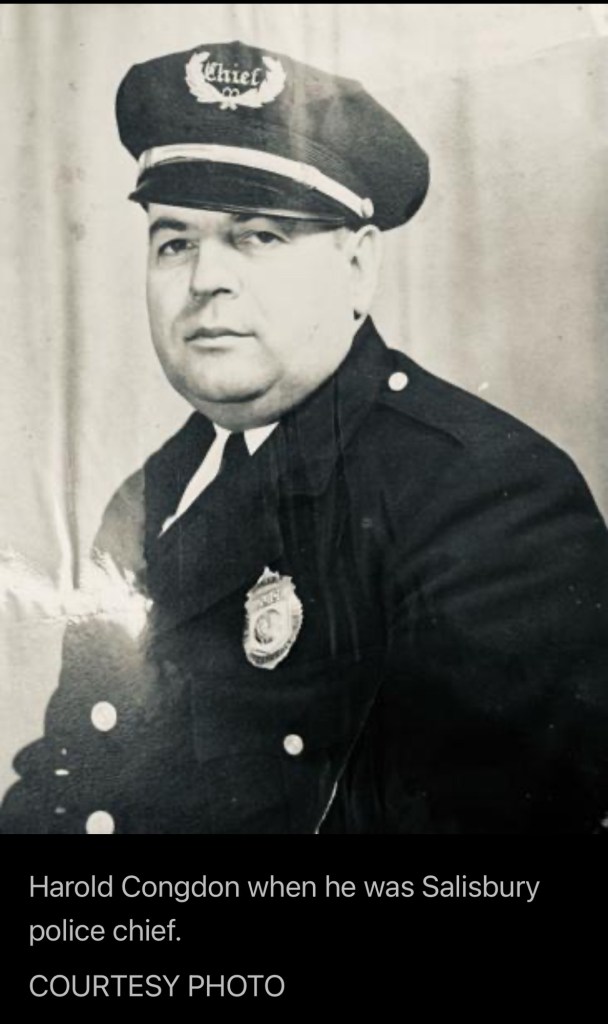
Pride goes before destruction, a haughty spirit before a fall, a proverb vividly illustrated by Harold Congdon’s story. After a four-month sentence for liquor crimes and conspiracy, Congdon, with his clever legal maneuvering, reclaimed his political positions as selectman and police chief. His return marked a controversial period in Salisbury’s history during Prohibition, where alcohol was readily available under his leadership, provided he was getting a piece.
On May 12, 1927, the Essex County Grand Jury indicted Congdon and nine associates, including his twin brother Harry and former town officials, on charges of graft. Their pay-to-play scheme involved kickbacks in exchange for overlooking alcohol-related offenses, embodying a system deeply rooted in corruption.
After its 1920 fire, the Ocean Echo was magnificently rebuilt, transforming into a bustling hub of entertainment. To the left, Joe’s Popcorn Stand marked the beginning of a line of attractions, followed by a beano hall, a dance club, a cocktail lounge, and a bathhouse, leading up to the Salisbury swimming pool. During the Roaring Twenties, Dance Marathons became a nationwide craze. These endurance contests allowed nightclubs to operate round the clock, as dancers tried to outlast each other for significant prize money. The Ocean Echo emerged as one of the country’s premier venues for these marathon dances.
On May 20, 1927, the nation was enthralled by Charles Lindbergh’s historic transatlantic flight, prompting Salisbury Beach to plan a grand celebration in early June, featuring a dance marathon and fireworks. Among the attendees was George Taylor, a drifter and skilled dancer. He participated in the marathon on Friday night, dancing with vigor until exhaustion forced him to quit by Saturday morning. In search of a buzz, Taylor visited a barber supply store in Hampton, N.H., where he purchased several half pints of witch hazel, an aftershave with 15% alcohol, intended not for grooming but for consumption, along with a pair of sun goggles.
Stella Pomikali, a striking 21-year-old, had the opportunity to work at Salisbury Beach, selling photo packages to tourists seeking memorable souvenirs of their summer visits. Stella, originally from Poland, had migrated with her family to Lawrence, to work in factories. Balancing her daytime job at the mills, she diligently pursued her education through evening classes. The summer job wasn’t just a chance to enjoy the season; it was also an opportunity for Stella to participate in the dance marathons at the renowned Ocean Echo.
On the morning of June 6, 1927, a couple from the Catania cottage in the south end set out for their regular walk. Their peaceful morning took a tragic turn when they discovered a lifeless body on the beach and quickly sought help. The victim who was identified as young Stella Pomikali, missing her wrist watch, with a pair of sun goggles close by. Arthur Williams, her employer, was the one to confirm her identity. She was brutally raped, and strangled.
For five weeks, Salisbury lived in fear until finally, on July 12, George Taylor was apprehended near the Canadian border. His arrest came after he confessed to consuming several half pints of witch hazel and waking up the next morning with Stella’s watch in his pocket. This crucial piece of evidence linked him directly to the crime scene and Stella’s murder.
Harold’s 1927 trial was sparked by growing tensions between Salisbury Beach and the rest of the town. The beach residents, contributing most of the town’s revenue, felt neglected as they saw the uptown area benefiting more from their tax revenue. This disparity led to a petition by the beach residents to secede from Salisbury, which in turn played a crucial role in bringing about the charges against Harold. The petitioners’ grievances, aired before the state legislature, highlighted the lawlessness of town officials, including all three selectmen, and pointed directly at Harold.
Harold Congdon himself was a man of contradictions. On one hand, he was seen as a guardian of the people of Salisbury, known for his care for the poor and his welcoming approach to newcomers. On the other hand, his administration was marked by prejudiced practices. The release of “The Birth of a Nation” in 1915, which negatively depicted African Americans and glorified the Ku Klux Klan, resonated in predominantly white communities, including Amesbury, Newburyport, and Salisbury. This influence was evident in the way African American men were targeted for minor offenses like vagrancy, with their arrests publicized as a warning to black communities.
The trial of George Taylor for the murder of Stella Pomikali unfolded, casting a spotlight on the town’s darker aspects of consumption and violence. Taylor’s trial, with its grim details and sensational coverage, contrasted starkly with Harold’s, which included Salisbury’s societal and political rifts.
George Taylor was found guilty of murder and sentenced to execution by electric chair at the Charlestown State Prison Death House. Concurrently, Harold Congdon, alongside George, unsuccessfully appealed their respective sentences. On March 2, 1929, Harold began serving his 2-½ year sentence at the Salem House of Corrections. Merely four days later, George Taylor was executed, marking a grim and conclusive end to the most brutal murder in local history.
(With help from Kristen Packer, Jim Pollard, Gene Dean, Ron Guilmette, Tina Boucher, the Salisbury Public Library and Newburyport Public Library.)
Salisbury resident C.J. Fitzwater is a curious traveler, perpetually on the lookout for fresh frontiers. With each journey, he blends historical threads into his stories.
 Curious Traveler
Leave a comment