Oceanographer Robert Ballard undertook a secret mission funded by the U.S. Navy to locate two sunken nuclear submarines from the Cold War era, the USS Thresher and the USS Scorpion.
The mission aimed to assess environmental risks from their nuclear reactors and investigate possible Soviet involvement. With his extra time, Ballard was allowed to search for the famous Titanic shipwreck from 1912, only after completing this primary task.
On August 22, 1985, Ballard and his team discovered the submarines’ debris, scattered by the immense pressure at depth. Using this knowledge, they applied a similar method to locate the Titanic by searching for its debris trail on the ocean floor.
The strategy paid off, not only completing an important covert mission but also leading to the historic discovery of the Titanic. This mission was kept classified for many years.
Eighteen miles northeast of Salisbury as the crow flies, you will find Kittery, Maine. To journey into Massachusetts from Maine, you must pass through Salisbury, and the same applies to Kittery if you travel into Maine from Massachusetts via New Hampshire.
Kittery, along with Portsmouth, New Hampshire, just across the Piscataqua River, shares the U.S. Navy’s oldest continuously operating shipyard.
The Portsmouth Naval Shipyard was officially established in 1800, but the islands that comprise the shipyard had been building warships since the first British warship in the 13 colonies was built there 328 years ago. In 1777, the Ranger, the first American ship recognized by a foreign country and famously captained by John Paul Jones, was built here, as was the first vessel to fly the Stars and Stripes, the Raleigh.
Seavey Island was an ideal location for a shipyard due to its access to a protected port in a rapid pace tidal river, which provided ice protection, its availability of quality lumber, and a skilled workforce capable of building ships.
During World War I, Portsmouth built the first U.S. submarine, the L-8, initiating a long tradition of submarine construction at the shipyard. In World War II, 70 submarines were built at the base. After the war, the base became a hub for nuclear-powered submarines operating under the motto “From Sails to Atoms.”
Our lives are like video clips with soundtracks composed of our memories. My grandparents remember Dec. 7, 1941, as a day of infamy when Japan bombed Pearl Harbor, marking the start of the U.S. involvement in World War II.
My parents knew where they were on Nov. 22, 1963, when they heard about JFK being assassinated. The moon landing in July 1969 had the world mesmerized. The stunning Challenger explosion in 1986 was Gen X’s first live-action tragedy. The O.J. Simpson verdict had us all tuned in, and we all watched as the second flight crashed into the South Tower on Sept. 11, 2001, leaving us all glued to the TV. We all remember those significant moments in our history.
On April 10, 1963, a phone call came into a home in the South End of the pre-urban renewal city of Portsmouth. Bob Merrill, 7, sat by, listening intently. He could sense his mother’s concern as she talked about their family friend, Walter Noonis, the chief radioman on the nuclear-powered submarine Thresher.
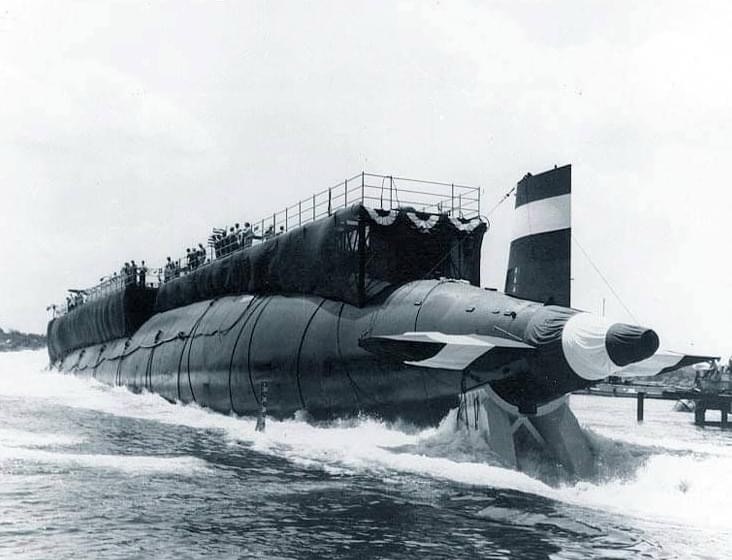
The USS Thresher, the fastest and quietest ship of her time, with the motto “Silent Strength” and nicknamed the “Submarine Killer,” was built to seek and destroy Soviet submarines. As the call ended, Bob learned that the Thresher, the lead class of its submarine, was lost at sea.
A day earlier, after meeting up with the submarine rescue ship the USS Skylark, the Thresher and her crew of 129 men began test diving. On the second day of diving, the Skylark received a garbled communication from 33-year-old Walter Noonis indicating “.. .minor difficulties, have positive up-angle, attempting to blow,” followed by a final, even more garbled message that included the number “900.”
These were the last communications with the Thresher before she imploded, scattering debris over an area 8,400 feet below on the ocean floor, 190 nautical miles east of Cape Cod. Initially, a faulty brazed joint was believed to be the cause, but this theory, along with every other explanation for the submarine’s implosion, has been continually challenged.
The loss of the Thresher and the death of family friend Walter Noonis was devastating for Bob as it was his first experience with tragedy. These sailors came from all over the United States, including sonarman Robert Steinel, a father of three who was born in Cleveland, built his home on Railroad Avenue in Salisbury, and was a Master Mason like John Paul Jones, having been raised at St. John’s Lodge in Newburyport.
Thirteen-year civilian shipyard employee and electronics technician Robert Charron, a friend and co-worker of Frank Cousins Sr. who lived and was raising his five children along with his wife, Ruth, on Federal Street in Newburyport, was one of 17 civilians who perished that day.
Donald Day, a 20-year-old submariner who lived on Inn Street in Newburyport at one time, also lost his life, leaving behind his wife, Jane, and a daughter. A commemorative memorial is dedicated to the sailors at Arlington National Cemetery, a park was dedicated to Robert Steinel at the beach center in Salisbury, and there are memorials throughout the country dedicated to the lost sailors.
If you go to the traffic circle in Kittery, you will find a flagpole that stands 129 feet high, each foot dedicated to every hero lost on the Thresher.
The opening verse from The Kingston Trio’s “The Ballad of the Thresher” goes, “Oh, the Thresher, the finest atomic ship; That ever dived for the sea; Each man on board was a volunteer; Was there ‘cause he chose there to be.”
Followed by the chorus, “Every man jack on board was a hero; Every man jack on board there was brave; Every man jack on board was a hero; Each man risked a watery grave.”
In 1965, the Portsmouth Naval Shipyard was one of 95 military bases slated for closure, but the decision was rescinded by President Richard Nixon after a 10-year extension saved the shipyard. That threat was duplicated in 2005, only to be saved by organized employees who mounted the “Save our Shipyard” movement that convinced a reversal of the decision to put the yard on the base closure list.
There is an ongoing dispute about whether the shipyard belongs to Maine or New Hampshire. In 2001, the U.S. Supreme Court dismissed New Hampshire’s claim, but in 2006, New Hampshire legislators reaffirmed its asserted sovereignty over Seavey Island and the base.
Many of the finest workers come from Kittery, Maine, and have worked at the shipyard. I work with some retired shipyard workers who are incredibly skilled and reliable. In 1800, Navy Secretary Benjamin Stoddert originally chose Portsmouth/Kittery for the shipyard because of the area’s proven workforce, a decision that has stood the test of time.
Deep in the belly of the ocean lies the graveyard of many sunken ships, including the famous German battleship Bismarck, the USS Lexington, the USS Thresher, and the most famous shipwreck of them all, the Titanic.
The shipyard, the families of the sailors, the Portsmouth Navy Shipyard community, the country, and Bob lost a bit of their innocence that fateful day 61 years ago. Let’s try to never forget the “Ghost in the Ocean.”
With help from Keith Moulton, Mike Flaherty, Amy Dame, Bob Merrill, Tom Sanford, Frank Cousins Jr., and the Kittery Historical and Navy Museum.
Salisbury resident C.J. Fitzwater is a curious traveler, perpetually on the lookout for fresh frontiers. With each journey, he blends historical threads into his stories. Email him at: cfitzwater@ymail.com.
 Curious Traveler
Leave a comment