Curious Traveler | C.J. Fitzwater Feb 21, 2024
On Sunday, Aug. 15, 1938, a service at the East Parish marked the beginning of Salisbury’s 300-year celebrations.
The venue was so packed that additional seating had to be arranged on the sidewalk outside the church. This event kicked off a week full of festivities, including a massive parade on Tuesday that drew thousands.
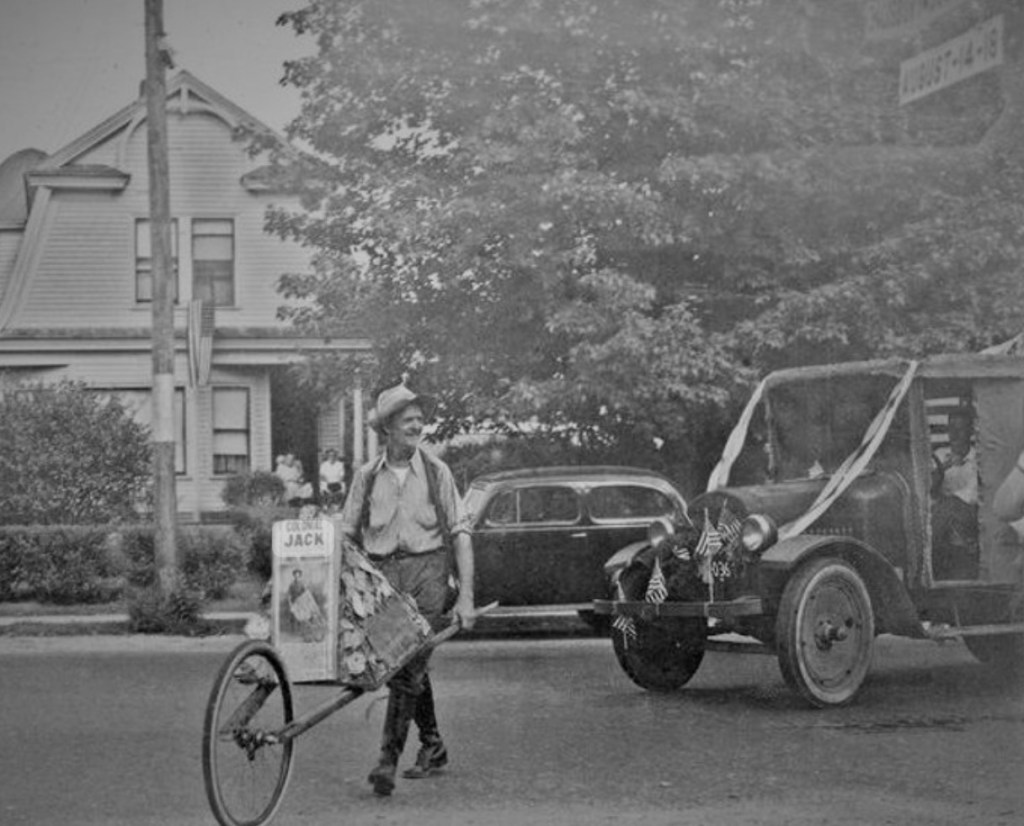
Among the attendees was John Albert Krohn, also known as “Colonial Jack.” He is celebrated in his now-adopted town as a Yankee eccentric. He was a jack of all trades; not just a printer, then a theatrical manager, and finally a strawberry farmer, but also an innovator who brought a unique zest to his ventures.
His signature attire consisted of homespun brown knickerbockers, a tricorn Colonial hat that matched the design of his uniquely pyramid-designed wheelbarrow, “The Sphinx,” symbolizing his adventurous spirit and poetic mind.
It had been over 30 years since he first wore this outfit, an outfit that drew attention as he embarked on a transcontinental trek that would create a sort of American folklore. Colonial Jack ventured forth with the determination of a man whose life was staked on the journey. His departure was marked by a ceremonial send-off by a cheering crowd outside City Hall in Portland, Maine.
A speedometer attached to “The Sphinx” for accurate mileage tracking and collecting postage marks as evidence of his visits, Krohn’s journey was meticulously documented. His travels were fraught with challenges, from hostile dogs to encounters with “mighty tough fellows.” Yet, his resilience and resourcefulness, armed with a six-shooter for protection, earned him a “wholesome respect” from even the most dubious characters.
During his journey, Colonial Jack survived by the generosity of those he met, receiving comfortable accommodations and hot meals. Though his wife joined him at various stages, her ill health in Idaho required her return home, leaving Krohn to face the vast stretches of America alone. He once covered 46 miles in one day while traveling through New Mexico.
Colonial Jack supplemented his income by selling aluminum tokens commemorating his journey, he leveraged his celebrity status to secure funds for his travels and ultimately broke a pedestrian record.
Pedestrianism was a 19th century form of competitive walking. The walkers made their money through wagering; it is the predecessor to the Olympic sport of race walking.
Baseball, and other spectator sports. overtook competitive walking in popularity in the early part of the 20th century. In 1908, Jack Krohn was one of the last heroes of the sport when he set a record.
He walked 9,024 miles in 357 days around the entire border of the United States visiting 1,209 cities, went through 11 pairs of shoes, 112 pairs of socks, five wheels and three tires on his wheelbarrow.
The publication of the book “The Walk of Colonial Jack” by the Newburyport Herald in 1910 is a chronological journal of his trip, and a celebration of the American people he met along the way.
Since his journey around the border, Jack had experienced the loss of one wife through death and another through divorce. With his third but not final spouse, he bought a farm on Elm Street in Salisbury.
Dressed in overalls, he cultivated strawberries, blueberries, watermelons and various other fruit, selling them from his roadside stand to tourists heading to popular Salisbury Beach.
Jim Pollard, unusually tall for his 10 years but often mistaken for 13, combining his height and his charm of the farmer’s wife, Jimmy was just the right age to be employed by the eccentric farmer.
The strawberry fields appeared endless, stretching from Elm Street to the railroad tracks, and required numerous hands to harvest the plump berries. Offering five cents a bushel, Jack demanded diligent work from the youngsters for their water breaks, strategically placing water barrels across the fields to ensure they were well-earned.
Despite the rigorous work during the summer harvest, it offered youths, like Jim, the chance to make a dollar after a hard day’s work. With his earnings, Jim could catch the train at the Salisbury Depot for a nickel to Newburyport to see a movie at the Strand Theater on Green Street for another nickel.
The tricentennial celebration in Salisbury gave the old farmer an opportunity to bring out the “Sphinx” once again, share tales of his youthful escapades, and sell some of his leftover coins and books, while perhaps also gauging interest in a possible new walking adventure.
Jack, born in Minnesota in 1873, moved to Newburyport before he spent the majority of his life in Salisbury, a town that came to embrace him as one of its own. Salisbury is known for its welcoming nature toward newcomers, despite a small faction within striving to uphold a divisive barrier.
Salisbury’s character lies in its generosity. Gaining national fame as Colonial Jack, he found his true place in this beach town up until his death at 83 years old in 1956.
Over at Ring’s Island, the Woodards had a grandson, James Taylor, who penned a song influenced not only by his father but also by a tale his mother, Trudy, who sang at Salisbury’s tercentenary celebrations, recounted to him in his youth.
The opening lines of “The Walking Man”: “Moving in silent desperation, keeping an eye on the Holy Land, a hypothetical destination. Say, who is this Walking Man?”
The answer comes directly from the introduction of the autobiography by Krohn, “The Walk Of Colonial Jack”.
“Why did I push a wheelbarrow around the border of the United States? To make money by selling my story.” But “the love of money is the root of all evil. Yes; still, most of us need the ‘root. Could I find a stronger motive? What is the object of all human endeavor? That which makes all men false is true itself. A man may trust it when father cheats him, brother, friend, or wife. As I am not a novelist, these chapters are the simple story of a plain man.”
(With help from Fred Knowles, Jim Pollard, Jack Sanborn, Newburyport Public Library, Salisbury Public Library, Nina Fitzwater, Terry Kyrios and Kristen Packer.)
Salisbury resident C.J. Fitzwater is a curious traveler, perpetually on the lookout for fresh frontiers. With each journey, he blends historical threads into his stories. Email him at: cfitzwater@ymail.com.
 Curious Traveler
Leave a comment