Curious Traveler
C.J. Fitzwater
Early this year, James Russell from the Custom House Maritime Museum asked me to put together a lecture on the life of Benjamin Franklin Butler, known around here for the Salisbury Beach toothpick.
I obliged, naturally, and brought along my Tom Sawyer-like friend, Larry Bertram, for the ride. Larry is the sort of fella who shows up with a backpack, two library cards and a book of poetry in his back pocket. He’s also got a knack for asking just the kind of questions that make librarians lean in and historians work hard to find answers.
So off we went down the Merrimack River, not on a raft like Huck and Jim, but from one library to the next, starting in Lowell, where I introduced Larry to a boott mill – a breakfast sandwich, egg, choice of corned beef hash, sausage, ham, or bacon, and fried taters on a bulky roll — that traces its roots back to what Boott Mill workers used to eat before the morning whistle blew. We got ours at Arthur’s Paradise Diner. From there, we meandered downriver, stopping at every library we could find. Along the way, we wandered into churches, graveyards, museums, and town halls, chasing the long shadow of Ben Butler, trying to figure out what kind of man leaves behind a story as wide and turbulent as the river itself.
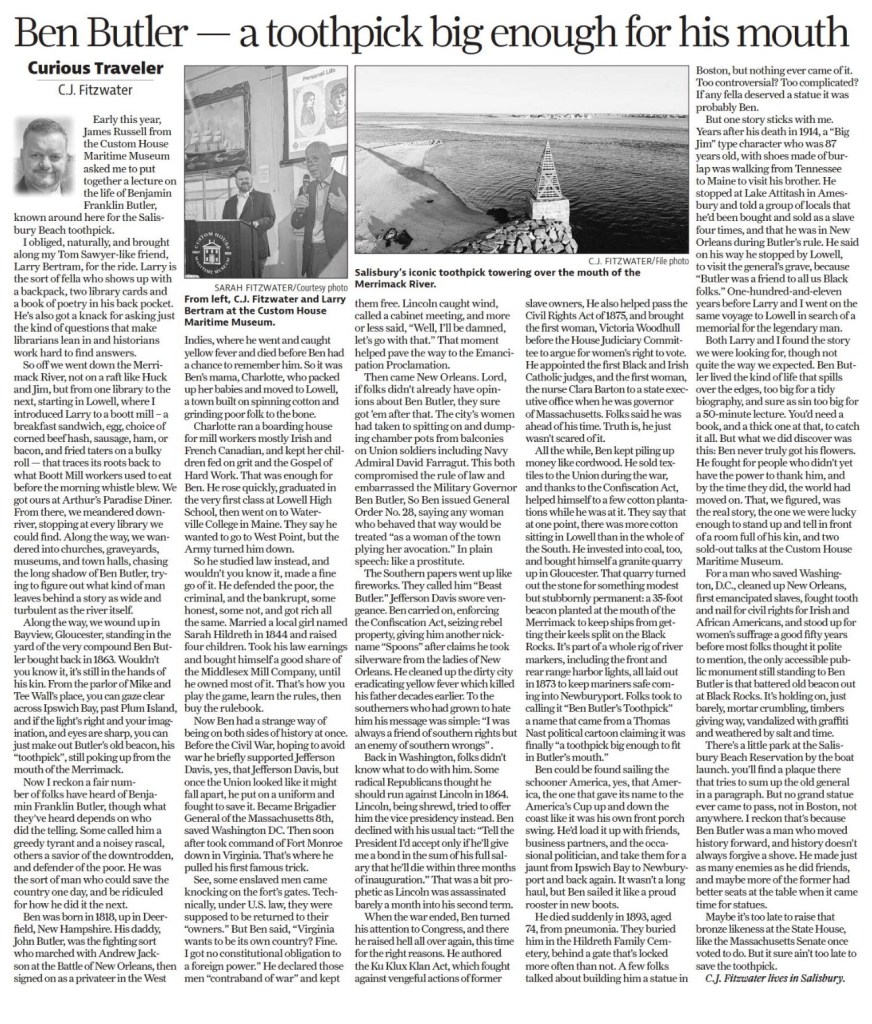
Along the way, we wound up in Bayview, Gloucester, standing in the yard of the very compound Ben Butler bought back in 1863. Wouldn’t you know it, it’s still in the hands of his kin. From the parlor of Mike and Tee Wall’s place, you can gaze clear across Ipswich Bay, past Plum Island, and if the light’s right and your imagination, and eyes are sharp, you can just make out Butler’s old beacon, his “toothpick”, still poking up from the mouth of the Merrimack.
Now I reckon a fair number of folks have heard of Benjamin Franklin Butler, though what they’ve heard depends on who did the telling. Some called him a greedy tyrant and a noisey rascal, others a savior of the downtrodden, and defender of the poor. He was the sort of man who could save the country one day, and be ridiculed for how he did it the next.
Ben was born in 1818, up in Deerfield, New Hampshire. His daddy, John Butler, was the fighting sort who marched with Andrew Jackson at the Battle of New Orleans, then signed on as a privateer in the West Indies, where he went and caught yellow fever and died before Ben had a chance to remember him. So it was Ben’s mama, Charlotte, who packed up her babies and moved to Lowell, a town built on spinning cotton and grinding poor folk to the bone.
Charlotte ran a boarding house for mill workers mostly Irish and French Canadian, and kept her children fed on grit and the Gospel of Hard Work. That was enough for Ben. He rose quickly, graduated in the very first class at Lowell High School, then went on to Waterville College in Maine. They say he wanted to go to West Point, but the Army turned him down.
So he studied law instead, and wouldn’t you know it, made a fine go of it. He defended the poor, the criminal, and the bankrupt, some honest, some not, and got rich all the same. Married a local girl named Sarah Hildreth in 1844 and raised four children. Took his law earnings and bought himself a good share of the Middlesex Mill Company, until he owned most of it. That’s how you play the game, learn the rules, then buy the rulebook.
Now Ben had a strange way of being on both sides of history at once. Before the Civil War, hoping to avoid war he briefly supported Jefferson Davis, yes, that Jefferson Davis, but once the Union looked like it might fall apart, he put on a uniform and fought to save it. Became Brigadier General of the Massachusetts 8th, saved Washington DC. Then soon after took command of Fort Monroe down in Virginia. That’s where he pulled his first famous trick.
See, some enslaved men came knocking on the fort’s gates. Technically, under U.S. law, they were supposed to be returned to their “owners.” But Ben said, “Virginia wants to be its own country? Fine. I got no constitutional obligation to a foreign power.” He declared those men “contraband of war” and kept them free. Lincoln caught wind, called a cabinet meeting, and more or less said, “Well, I’ll be damned, let’s go with that.” That moment helped pave the way to the Emancipation Proclamation.
Then came New Orleans. Lord, if folks didn’t already have opinions about Ben Butler, they sure got ’em after that. The city’s women had taken to spitting on and dumping chamber pots from balconies on Union soldiers including Navy Admiral David Farragut. This both compromised the rule of law and embarrassed the Military Governor Ben Butler, So Ben issued General Order No. 28, saying any woman who behaved that way would be treated “as a woman of the town plying her avocation.” In plain speech: like a prostitute.
The Southern papers went up like fireworks. They called him “Beast Butler.” Jefferson Davis swore vengeance. Ben carried on, enforcing the Confiscation Act, seizing rebel property, giving him another nickname “Spoons” after claims he took silverware from the ladies of New Orleans. He cleaned up the dirty city eradicating yellow fever which killed his father decades earlier. To the southerners who had grown to hate him his message was simple: “I was always a friend of southern rights but an enemy of southern wrongs” .
Back in Washington, folks didn’t know what to do with him. Some radical Republicans thought he should run against Lincoln in 1864. Lincoln, being shrewd, tried to offer him the vice presidency instead. Ben declined with his usual tact: “Tell the President I’d accept only if he’ll give me a bond in the sum of his full salary that he’ll die within three months of inauguration.” That was a bit prophetic as Lincoln was assassinated barely a month into his second term.
When the war ended, Ben turned his attention to Congress, and there he raised hell all over again, this time for the right reasons. He authored the Ku Klux Klan Act, which fought against vengeful actions of former slave owners, He also helped pass the Civil Rights Act of 1875, and brought the first woman, Victoria Woodhull before the House Judiciary Committee to argue for women’s right to vote. He appointed the first Black and Irish Catholic judges, and the first woman, the nurse Clara Barton to a state executive office when he was governor of Massachusetts. Folks said he was ahead of his time. Truth is, he just wasn’t scared of it.
All the while, Ben kept piling up money like cordwood. He sold textiles to the Union during the war, and thanks to the Confiscation Act, helped himself to a few cotton plantations while he was at it. They say that at one point, there was more cotton sitting in Lowell than in the whole of the South. He invested into coal, too, and bought himself a granite quarry up in Gloucester. That quarry turned out the stone for something modest but stubbornly permanent: a 35-foot beacon planted at the mouth of the Merrimack to keep ships from getting their keels split on the Black Rocks. It’s part of a whole rig of river markers, including the front and rear range harbor lights, all laid out in 1873 to keep mariners safe coming into Newburyport. Folks took to calling it “Ben Butler’s Toothpick” a name that came from a Thomas Nast political cartoon claiming it was finally “a toothpick big enough to fit in Butler’s mouth.”
Ben could be found sailing the schooner America, yes, that America, the one that gave its name to the America’s Cup up and down the coast like it was his own front porch swing. He’d load it up with friends, business partners, and the occasional politician, and take them for a jaunt from Ipswich Bay to Newburyport and back again. It wasn’t a long haul, but Ben sailed it like a proud rooster in new boots.
He died suddenly in 1893, aged 74, from pneumonia. They buried him in the Hildreth Family Cemetery, behind a gate that’s locked more often than not. A few folks talked about building him a statue in Boston, but nothing ever came of it. Too controversial? Too complicated? If any fella deserved a statue it was probably Ben.
But one story sticks with me. Years after his death in 1914, a “Big Jim” type character who was 87 years old, with shoes made of burlap was walking from Tennessee to Maine to visit his brother. He stopped at Lake Attitash in Amesbury and told a group of locals that he’d been bought and sold as a slave four times, and that he was in New Orleans during Butler’s rule. He said on his way he stopped by Lowell, to visit the general’s grave, because “Butler was a friend to all us Black folks.” One-hundred-and-eleven years before Larry and I went on the same voyage to Lowell in search of a memorial for the legendary man.
Both Larry and I found the story we were looking for, though not quite the way we expected. Ben Butler lived the kind of life that spills over the edges, too big for a tidy biography, and sure as sin too big for a 50-minute lecture. You’d need a book, and a thick one at that, to catch it all. But what we did discover was this: Ben never truly got his flowers. He fought for people who didn’t yet have the power to thank him, and by the time they did, the world had moved on. That, we figured, was the real story, the one we were lucky enough to stand up and tell in front of a room full of his kin, and two sold-out talks at the Custom House Maritime Museum.
For a man who saved Washington, D.C., cleaned up New Orleans, first emancipated slaves, fought tooth and nail for civil rights for Irish and African Americans, and stood up for women’s suffrage a good fifty years before most folks thought it polite to mention, the only accessible public monument still standing to Ben Butler is that battered old beacon out at Black Rocks. It’s holding on, just barely, mortar crumbling, timbers giving way, vandalized with graffiti and weathered by salt and time.
There’s a little park at the Salisbury Beach Reservation by the boat launch. you’ll find a plaque there that tries to sum up the old general in a paragraph. But no grand statue ever came to pass, not in Boston, not anywhere. I reckon that’s because Ben Butler was a man who moved history forward, and history doesn’t always forgive a shove. He made just as many enemies as he did friends, and maybe more of the former had better seats at the table when it came time for statues.
Maybe it’s too late to raise that bronze likeness at the State House, like the Massachusetts Senate once voted to do. But it sure ain’t too late to save the toothpick.
C.J. Fitzwater lives in Salisbury.


 Curious Traveler
Leave a comment