Curious Traveler: CJ Fitzwater
“Give me a museum and I’ll fill it.”
— Pablo Picasso
Last March, my wife, Nina; her childhood best friend, Sarah Emanuel; and I traveled to Puerto Rico.
Sarah is always up for an adventure, and we were eager to escape late winter for a bit and show her around our favorite place in the Caribbean.
The food, history and culture, along with how safe and easy it is to travel to, make it a destination that should be on every traveler’s list. The island reminds me of something between Barcelona with its heavy European influence on art, and architecture, and West Virginia with its folk-like vibes of the Boriquas and beautiful mountain hollows.
On a rainy afternoon, we made our way into Old San Juan to visit the historic Castillo San Felipe del Morro, the castle-like citadel built in 1539 at the northwestern edge of San Juan. Along with Castillo San Cristóbal, these UNESCO World Heritage Site forts were constructed to protect the islet of San Juan and guard the land entrance to the old city.
As we climbed the hill, we finished off a pina piragua (shaved ice) just as the skies opened up and had to find cover quickly. We ducked into Museo de San Juan, where an exhibition of Pablo Picasso, one of the most influential painters of the 20th century, had just opened.
The exhibition, titled “Picasso in San Juan: Lithographic Portfolios,” brought together 40 works spanning the master’s artistic production from 1899 to 1955. Displayed in the museum’s Sala Oller, the lithographs offered a rare look at Picasso’s evolution, revealing intimate and lesser-known works during his prime.
The exhibition allowed Nina, Sarah and I to appreciate iconic moments from across his career from the melancholy of his Blue Period to his bold experiments with cubism and the human figure.
Some series included lithographs and drawings that preceded his most recognized masterpieces, giving us a close and personal view into his creative process. Pablo had a process that went into creating his masterpieces. The same way a writer uses different drafts to move a story, Picasso used different drafts to evolve his masterpieces, and the exhibition laid out that story for us to interpret.
The portfolios were original lithographic prints drawn from works Picasso first created in pencil, pastel, paint, watercolor, charcoal, and etching. Among them was “The Blues of Barcelona,” a collection of 11 pieces and a lithographic poster that carried the weight of his Blue Period.
There were also intimate drawings devoted to his muse, Geneviève Laporte. My favorite art usually comes from the perspective of a man inspired by the beauty of a woman.
Picasso understood women have the power to choose who they will love, and hold the magical powers to eternity by giving life. As we wandered through the gallery, we found ourselves narrating our own interpretations, letting the stories on the walls come alive in front of us.
The exhibition continued with sketches for “The Women of Algiers” and ended in the series “Dancers”, a set of 14 lithographs highlighting Picasso’s ability to capture movement and anatomy with simplicity. The hardest thing to capture in a still is movement.
This was my first experience falling in love with Picasso. Seeing such a breadth of work in one place allowed us to understand his genius. With 40 pieces to examine, we were immersed in his compositions and creative evolution.
One reason Picasso remains so important is the length of his career. He lived to be 91 and created for 73 years. No world-class museum feels complete without a Picasso.
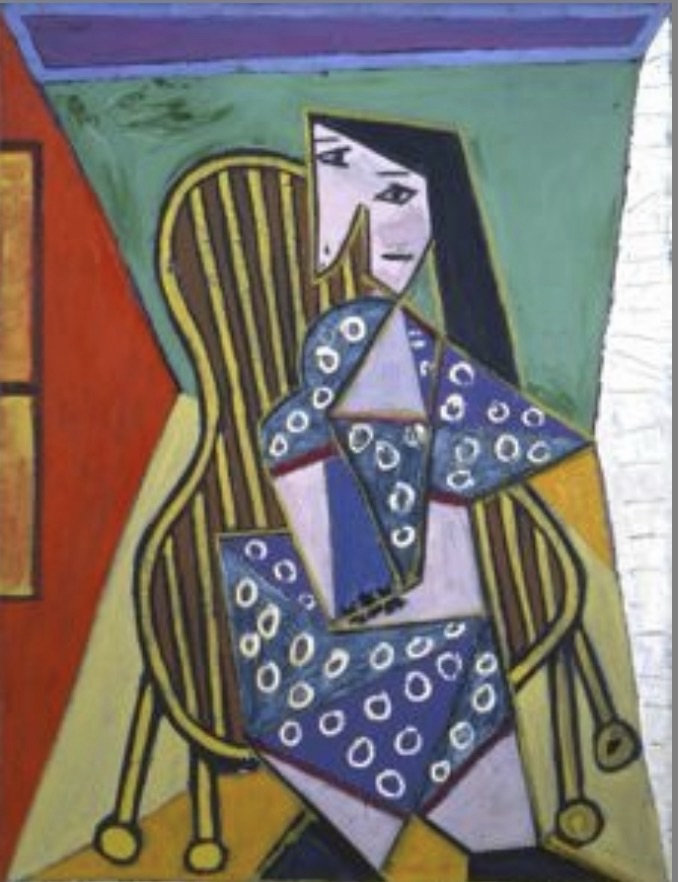
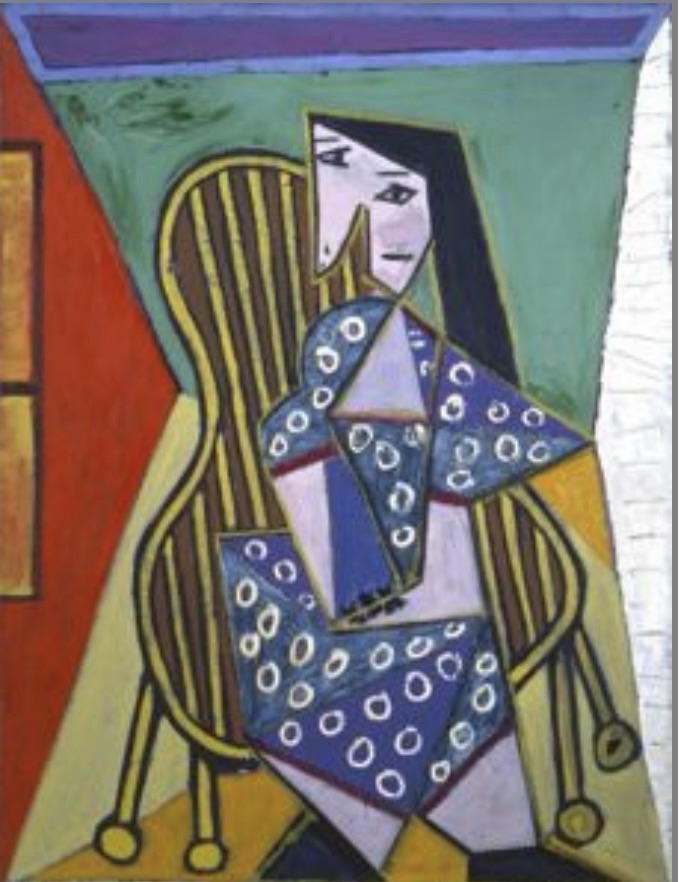
Closer to home, you can find his work at the Currier Museum of Art in Manchester, New Hampshire, where his oil painting “Woman Seated in a Chair” depicts the distorted, geometric form of Dora Maar, his lover in the late 1930s painted in Nazi-occupied Paris in 1941 during his late cubist period.
Cubism, the avant-garde movement Picasso helped pioneer, broke subjects apart and reassembled them in abstracted form. His genius lay in using that fractured language of form to tell a story.
Over his lifetime, Picasso created more than 13,500 paintings, over 100,000 prints and engravings, as well as sculptures and illustrations, leaving behind one of the most prolific bodies of work in art history.
His art can be found throughout New England, including the Museum of Fine Arts, Boston, the Harvard Art Museums (home to the Fogg Museum), the Worcester Art Museum, the Rose Art Museum at Brandeis University, the Portland Museum of Art, which includes Picasso ceramic vases, and even the Rochester Museum of Fine Arts in New Hampshire.
Enchanted (a feeling of great pleasure; delight) was how Pablo felt about his subjects, and to create great art, that may be the most important feeling of all. Puerto Rico is the “Island of Enchantment,” and though Picasso never visited, I’m sure he would have made great art there.
Picasso left little doubt that he would be remembered. His work seems to wait in galleries across the world.
As part of my vocation, I travel throughout New England, and whenever I have the chance to slip into a fine arts museum, I take it. More often than not, I find my old enchanting friend Pablo giving us something new, and still filling the room.
Thanks for reading and supporting local journalism. “Curious Traveler” is a series of stories written by Salisbury resident C.J. Fitzwater about people, places and things. If you’re interested in meeting, sharing a meal and telling your story, send him an email at cfitzwater@ymail.com.
 Curious Traveler
Leave a comment