Curious Traveler | C.J. Fitzwater
“We hold these truths to be self-evident, that all men are created equal, that they are endowed by their Creator with certain unalienable Rights, that among these are Life, Liberty, and the Pursuit of Happiness.” — Thomas Jefferson
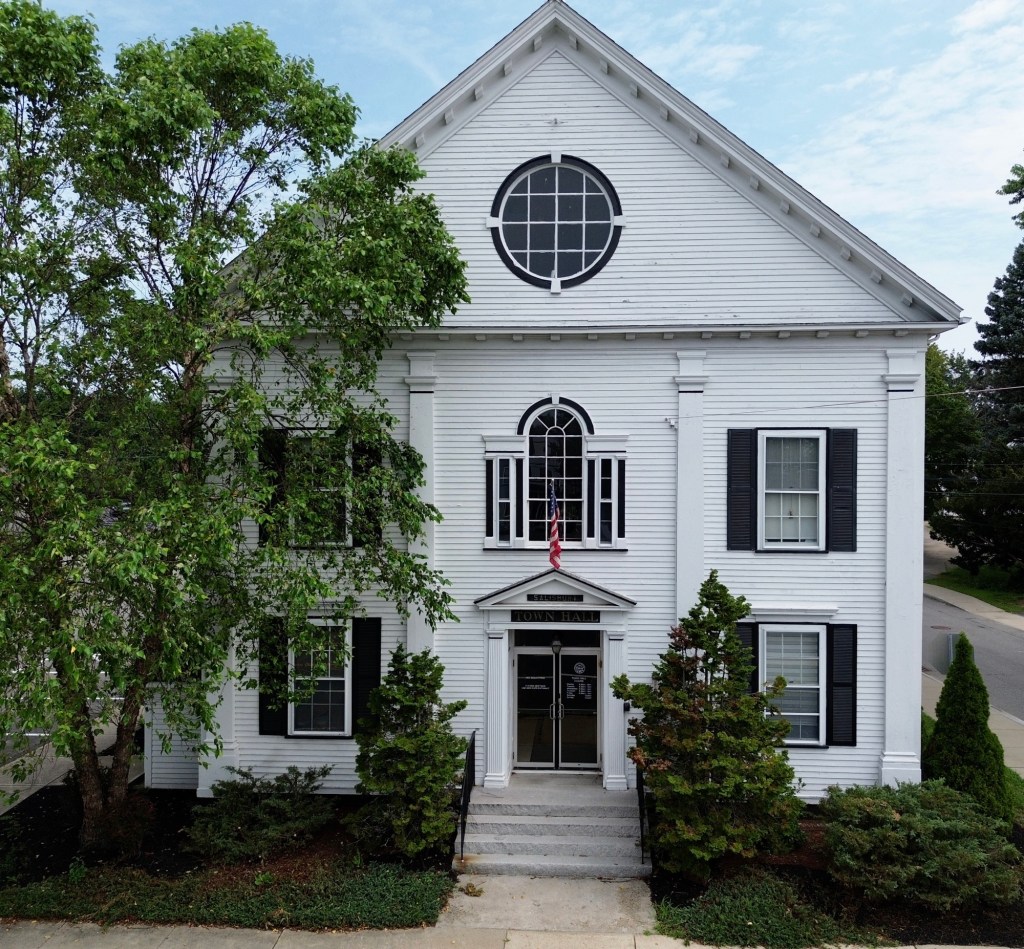
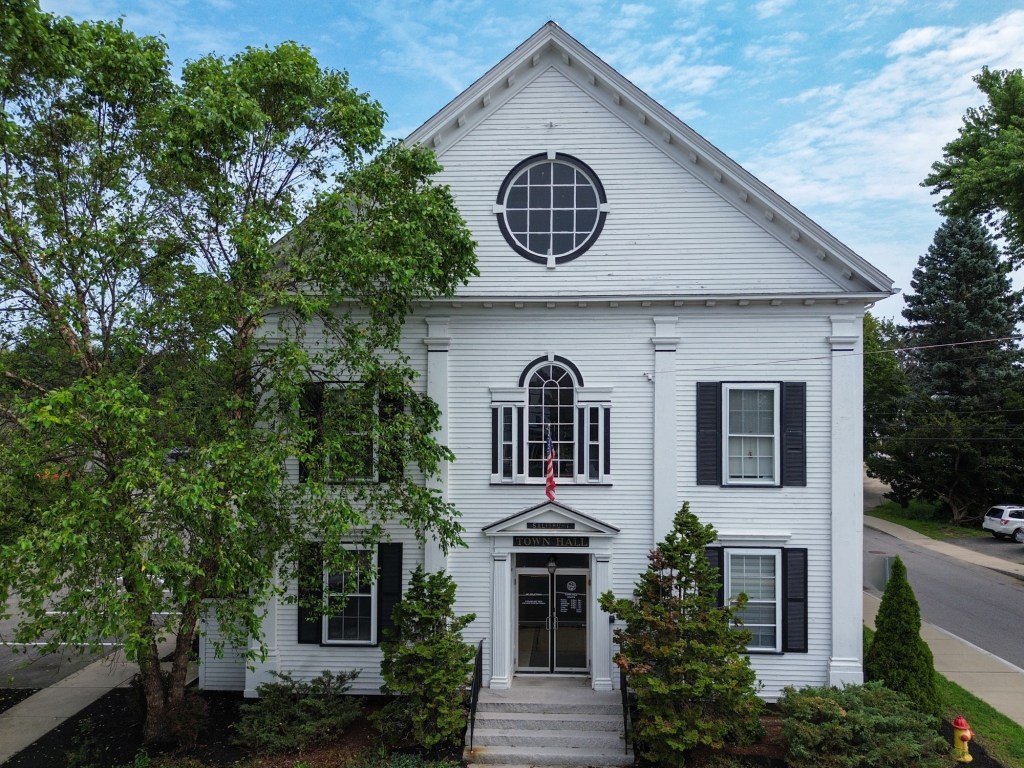
I walked into the town clerk’s office at Salisbury Town Hall a few weeks ago looking for any information I could find about George Washington’s visit to Salisbury in 1789 during his post-election campaign. The purpose of that campaign was to build support for the new government under the recently adopted Constitution of the United States. Melinda Morrison showed me to a large, beautiful ledger containing the town’s records dating back to 1638.
The first record stated, “Merrimack was granted to be a plantation unto Mr. Simon Bradstreet, Mr. Daniell Denisonn, Christopher Bratt, Samuel Winsley, Samuel Dudley, and John Saunders. Orders made and certain lands given to them as folls.”
The following year, the town’s borders were established, and from that point on, Salisbury continued to hold regular Town Meetings. As I read through those records, I began to understand how the town functioned. The government of Salisbury consisted primarily of a moderator, three selectmen, a constable, a surveyor of trees and lumber, a surveyor of highways, a sealer of weights and measures, and, of course, the town clerk.
As the town grew, these roles evolved, changed or became obsolete. Elections were held annually, and to vote legally, one had to be “an inhabitant twenty-one years old and upward, having a freehold estate of the annual income of three pounds or any estate of the value of sixty pounds.”
King George’s Intolerable Acts restricted town meetings in an effort to control the colonies. The intent was to quiet the growing drumbeat for independence.
That steady rhythm had been building since the end of the French and Indian War, which secured for Great Britain all land east of the Mississippi River. Burdened by war debt, Parliament passed the Sugar, the Stamp, then the Townshend acts, including the tax on tea. With each new action by the crown, the drumbeat for independence grew louder.
In 1774, British soldiers fired on colonial rebels at Fort William and Mary. Four months later, the battles of Battles of Lexington and Concord erupted into open war, followed by the Battle of Bunker Hill. The early years of the conflict, from 1775 to 1776, proved that although losses were taken, the colonial forces could stand toe-to-toe with the most powerful army in the world. Confidence began to grow.
By June 1776, the Second Continental Congress met in Philadelphia and formed a five person committee to write a Declaration of Independence that included Robert R. Livingston, Roger Sherman, Benjamin Franklin, John Adams, and a young Thomas Jefferson. Franklin brought wisdom and experience. Adams, a lawyer from Boston, was outspoken, confident, and knowledgeable in law. Jefferson, just 33 years old, was a farmer, scientist, and advocate for democracy and natural rights.
Jefferson was influenced by the writings of many Age of Enlightenment philosophers, including Jean Jacques Rousseau, and John Locke, whose theory of the social contract held that “governments derive their power from the consent of the governed and that, when they fail to protect natural rights, they may be altered or abolished.”
Though Adams was initially expected to draft the document, he encouraged Jefferson to take the lead, recognizing his philosophical studies and literary skill. Jefferson, an avid reader with an extensive library, is an example that good writing comes from prolific reading.
Jefferson, working in isolation in a rented room in Philadelphia, surrounded by books, including Leviathan by Thomas Hobbes, argued that humans once lived in a state of nature without government, where life was “solitary, poor, nasty, brutish, and short.” To escape that condition, people had to come together and consent to governing authority. Between June 11 and June 28, 1776, Jefferson composed his draft of the Declaration.
The second sentence begins with the word “We,” which raises the question: who were the “We”? Some would argue women were not included. One could also argue that women were considered part of that “We,” represented by the head of the household, their husband or father. That interpretation is controversial now, but in matters of decision-making, the voting male was expected to act in what he believed was the best interest of his family or those within his power, serving in a representative role, for better or worse. Abigail Adams made her thoughts clear in a letter to John Adams, urging him to “Remember the ladies, and be more generous and favorable to them than your ancestors.” It would not be until 1920 that women gained suffrage.
Originally, after “We hold these truths,” Jefferson wrote “sacred and undeniable,” but Franklin edited it to “self-evident.” To Jefferson’s dismay his work was edited not only by Franklin, who was twice his age, but also by the others. Following “self-evident” comes “that all men are created equal,” a statement that overlooked Native Americans, the reality of enslaved people and the fact that women could not vote. Jefferson himself had referred to the slave trade as “a cruel war against human nature,” yet his ownership of more than 600 enslaved people stood in clear contradiction. Adams opposed the slave trade, once stating, “I always feel a kind of indignation at the sight of a slave.” The committee understood that any attempt to abolish slavery would not pass Congress, and so references to it were removed.
The phrase “that they are endowed by their Creator with certain unalienable Rights” was originally written as “that from that equal creation they derive rights.” Adams, who was more of a traditional religious man, helped insert the reference to a Creator, while Jefferson, who may have held more agnostic views and even rewrote the Gospels to emphasize moral teachings over miracles, had not emphasized it in the same way. The term “unalienable” was also changed by Adams from “inalienable,” though the meanings are essentially the same; interestingly, “inalienable” appears on the Jefferson Memorial.
Then comes the crescendo of the sentence: “that among these are Life, Liberty, and the Pursuit of Happiness.” This idea had been developing for years. In 1772, Samuel Adams wrote in the Boston Pamphlet, (which was also printed in Salisbury’s permanent record) that “The most essential rights of mankind are life, liberty, and property.” Just a month before the Declaration, George Mason expressed a similar idea in Virginia’s Declaration of Rights, speaking of inherent rights including “the enjoyment of life and liberty… and pursuing and obtaining happiness and safety.” All of these ideas trace back to the social contract theory of John Locke.
The middle section of the document included 27 grievances against the king, including suspending colonial laws, dissolving the House of Representatives, obstructing justice, and maintaining standing armies among the colonies. It outlined the reasons for legal separation, similar to a divorce. It was followed by the formal announcement of the colonies’ separation from Great Britain, establishing their legal rights, and ending with, “And for the support of this Declaration, with a firm reliance on the protection of divine Providence, we mutually pledge to each other our Lives, our Fortunes and our sacred Honor.” It was then signed by John Hancock and the other 55 delegates.
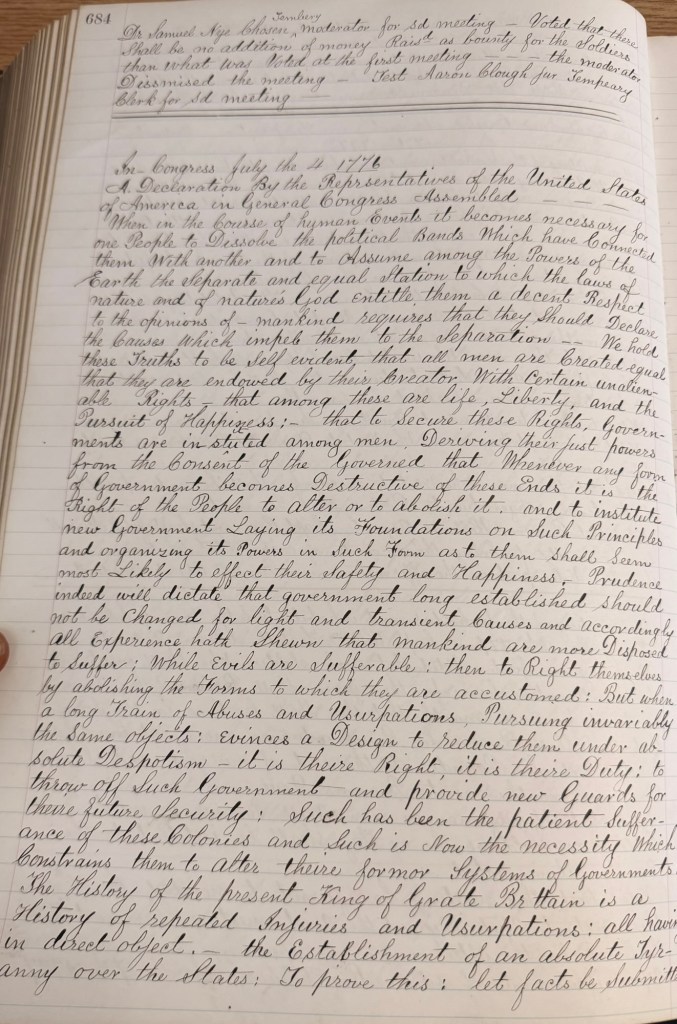
I’ve always liked finding a bookmark in a library book and opening it to see what someone before me thought was worth marking. When I walked into Salisbury Town Hall and was given the chance to explore the town records, from the founding of the Merrimack Plantation in 1638 through 1873, I found just such a moment. Inside was a bookmark stamped by former Town Clerk Wilma Mahoney McDonald.
As I read, I discovered a full copy of the Declaration of Independence. After its ratification, it had been printed as large broadsides by John Dunlap, with orders that copies be sent to ministers of every parish to be read aloud and then recorded for permanent record by town clerks. You can imagine the excitement of uncovering this ancient footprint and beautifully written document.
George Washington, upon receiving his broadside copy while defending New York, ordered the document read aloud on the commons in Lower Manhattan. Afterward, a crowd tore down the equestrian statue of King George, cut off its head, and melted the rest into 42,088 musket balls.
Thomas Jefferson and John Adams became political rivals, and their relationship soured when they ran opposing campaigns for president after George Washington. Adams became the second president, and under the law at the time, the runner-up served as vice president. Jefferson won the next election, and his greatest accomplishment as president was the Louisiana Purchase, which doubled the size of the country.
The two later reconciled, and in poetic fashion, both men died on July 4, 1826, exactly 50 years after the ratification of the Declaration of Independence. Jefferson’s last words were “This is the fourth,” while Adams’ final words were “Thomas Jefferson survives,” not knowing he had died hours earlier. President John Quincy Adams, a former Newburyport resident, spoke of the coincidence, calling it “visible and palpable remarks of divine favor.”
Thanks to Dana Echelberger of Newburyport Public Library and Salisbury Town Clerk Melinda Morrison for their help in research.
Thanks for reading and supporting local journalism. “Curious Traveler” is a series of stories written by C.J. Fitzwater. If you’re interested in meeting, sharing a meal, and telling your story, send him an email at http://cfitzwater@ymail.com.
 Curious Traveler
Leave a comment