Curious Traveler
CJ Fitzwater
“This is a life-seekers port of call, a disembarking to old and new, where history was made in calls to liberty and nation, to hearts of the enslaved, where builders of mighty ships went to sea; all past and present are the artist motif,”local poet John Burciaga.
George Washington crossed the Parker River Bridge, leaving his cream-colored carriage behind as he mounted his 16 hand-high white stallion, Prescott. Dressed in full uniform and accompanied by Senator Tristram Dalton from Newburyport, he made his way toward Newburyport along the Eastern Post Road. As he reached the town line, he paused while an ode rang out: “He comes! He comes! The HERO comes! Sound, sound your trumpets, beat, beat your drums; From port to port let cannons roar He’s welcome to New England’s shore. Welcome, welcome, welcome, welcome, Welcome to New England’s shore!”
Washington was on this journey roughly six months after becoming the first president of the newly formed United States, with the goal of uniting a country that was anything but.
Washington lost more battles than he won, but his only surrender came in 1754 as a lieutenant colonel of the Virginia Regiment of the British Army during the French and Indian War at the Battle of Fort Necessity. The 22-year-old George fired the first shot of that war. During the Revolutionary War he was defeated at the Battles of Long Island, Brandywine, and Germantown against a far more powerful British Army, and was forced to retreat from Manhattan Island. Yet Washington had a remarkable ability to hold his armytogether, despite horrible conditions, and broken promises, and to inspire men who endured repeated hardships throughout the brutal war.
The war was at the same time a civil war and a revolution, eventually expanding into a world war.
Soldiers endured harsh conditions, lacking consistent wages, uniforms, and quality munitions. They faced starvation, disease, and infestations of lice so severe the “grey backs” as they were nicknamed waged their own war on the soldiers’ bodies.
He achieved his greatest victory at the Battle of Trenton following the miserable winter crossing of the Delaware. He was also in command when Charles Cornwallis surrendered at the Siege of Yorktown in October of 1789, the last major land battle of the war.
British forces were surrounded with the help of Marquis de Lafayette and the French Army, and Navy which forced the surrender.
With Great Britain simultaneously at war in Europe against France, Spain, and the Dutch Republic, the cost of maintaining control over thirteen of its twenty- six colonies in the Western Hemisphere became too great for the Crown. In the end, Washington and the Continental Army did not so much win the war as much as they survived it.
After the Treaty of Paris in 1783 formally ended the War for AmericanIndependence and recognized the United States as free, sovereign, and independent, George Washington stepped down as Commander-in-Chief of the Continental Army. It was a decision of enormous consequence, ensuring the new nation would not fall under the rule of a military dictator or king. Following the ratification of the Constitution on March 4, 1789, he was elected the nation’s first President.
The ratification of the Constitution was far from universally embraced. By replacing the Articles of Confederation and shifting power from the states to a strong federal government, it stirred deep concern among anti-Federalists.
Having just fought for independence from what they saw as tyranny, many feared a new form of it was on its way.
In the fall of 1789, he departed from New York City, then the nation’s capital, and set out for New England. Along the way, he chose to stay in taverns rather than accept the hospitality of wealthy hosts which was deliberate reinforcing that he was a man of the people, not indebted to elite influence. In doing so, he kept his independence allowing him to visit whomever he wished.
Meanwhile, Gov. John Hancock, then known as President of Massachusetts and one of its wealthiest citizens, expected the president to dine with him.
Washington declined, making it clear instead that the governor should come to him and pay his respects.
Hancock had initially been skeptical of the Constitution, concerned that it lacked a Bill of Rights and shifted too much power away from the states. Still, he presided over the stateratifying convention and ultimately supported adoption, recommending that amendments be addressed by the First Congress. This approach, philosophized by Theophilus Parsons of Newburyport, helped pave the way for other states to follow. When New Hampshire became the ninth state to ratify the Constitution, under Article VII, it now became the law of the land.
You can almost picture Hancock, so instrumental in ratification, eager and proud to host, and maybe even be saluted by Washington as he arrived in Boston, disappointed when his invitation was declined. Hancock eventually met with Washington at the Ingersoll Inn where the President stayed the four days he was in Boston to salute and thank him. This reinforced the idea of federal authority over the state power, exactly what George hoped to convey.
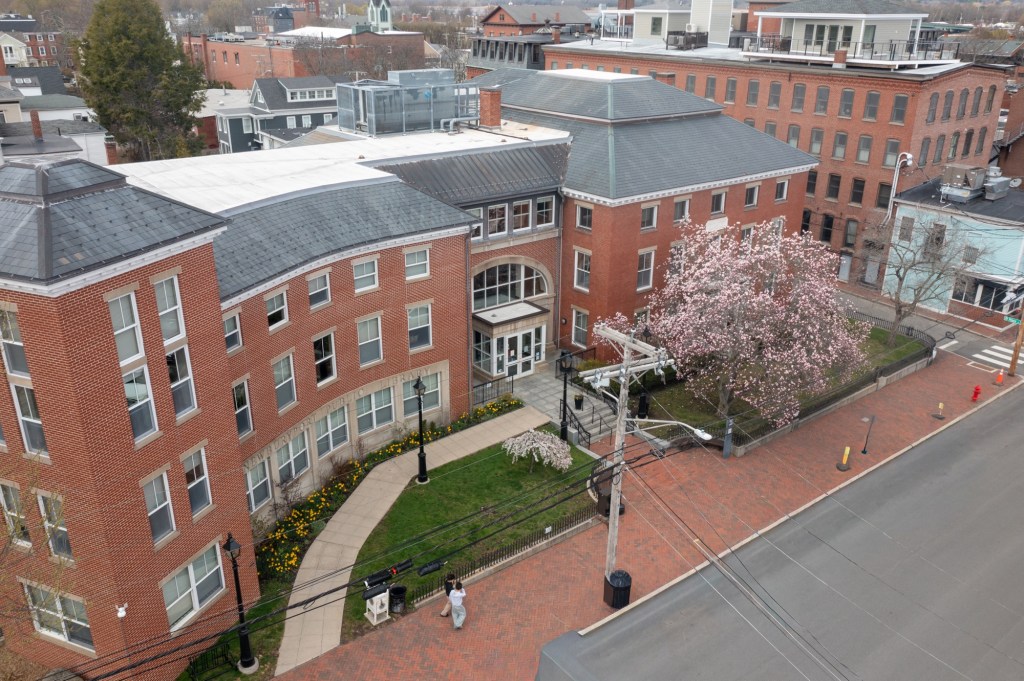
As the president arrived in Newburyport, he was escorted with his entourage to stay at the house of his Masonic Brother Nathanial Tracey, which still stands today as part of the Newburyport Public Library.
Yes, he slept right there, in the library. He was formally addressed and later received at the First Presbytery of the Eastward.
Where Theopolisis Parsons addressed the President “ Long, Sir, may you continue to ornament and support of these States, and may the period be late, when you shall be called to receive a reward, adequate to your virtues, which it is not in the power of your Country to bestow. “
In response to his reception, Washington remarked, “In visiting the town of Newburyport, I have obeyed a favorite inclination, and I am much gratified by the indulgence. In expressing a sincere wish for its prosperity, and the happiness of its inhabitants, I do justice to my own sentiments and their merit.” That evening, fireworks and “excellent rockets” exploded over the Merrimack River in celebration of the town’s distinguished guest.
The next morning,October 31st he had breakfast at the Dalton residence, where an elderly man requested an audience with the President. After being told Washington was unavailable, the request reached his ears, and he immediately rose to greet the visitor.
Upon seeing him, Washington instantly recognized the man as a loyal servant from the French and Indian War.
The President presented him with a “guinea”(gold British coin), which the man who was nicknamed “Colonel Cotton” later fashioned into a necklace, wearing it “until poverty obliged him to part with it.”
He was then escorted to a Newburyport Marine Society decorated barge, which carried him across the Merrimack River from Newburyport to near what is now Alliance Park at Salisbury Point. (Until 1886, this area of Amesbury was Salisbury). There he was greeted by a 21 gun salute from the Spanish Navy. Washington next visited the Salisbury West Parish, or Rocky Hill Meeting House, before continuing on to Training Field Park to observe militia exercises.
From there, the President was escorted across Salisbury Plains to the Post Road (Lafayette Road) at the New Hampshire border at Seabrook, where he was received by Gov.
John Sullivan, who, along with 700 mounted cavalry, guided him onward toward Portsmouth. The famed general-turned first president was met with cheers and celebration in every town he entered, taking time to greet former soldiers along the way. He eventually visited all thirteen states, evangelizing for a unified nation.
Tobias Lear, Washington’s secretary, raised in Portsmouth, New Hampshire, and educated at Governor’s Academy, was with the president when he died on Dec. 14, 1799. After confirming the instructions Washington had given for handling his death, the president’s final words were, “’Tis well.” News of the general’s passing did not reach the Lower Merrimack Valley until Christmas Day.
Bells rang out in Newburyport, Amesbury, and Salisbury from 4 p.m. until 9 p.m. in his honor.
Thanks to Dana Echelberger of the Newburyport Public Library, and Salisbury Town Clerk Melinda Morrison for their help in research, the quotes were taken directly from Newburyport, and Salisbury town records. I also referenced “History of Newburyport Massachusetts,” by John J Currier, and “Travels with George,” by Nathaniel Philbrick.
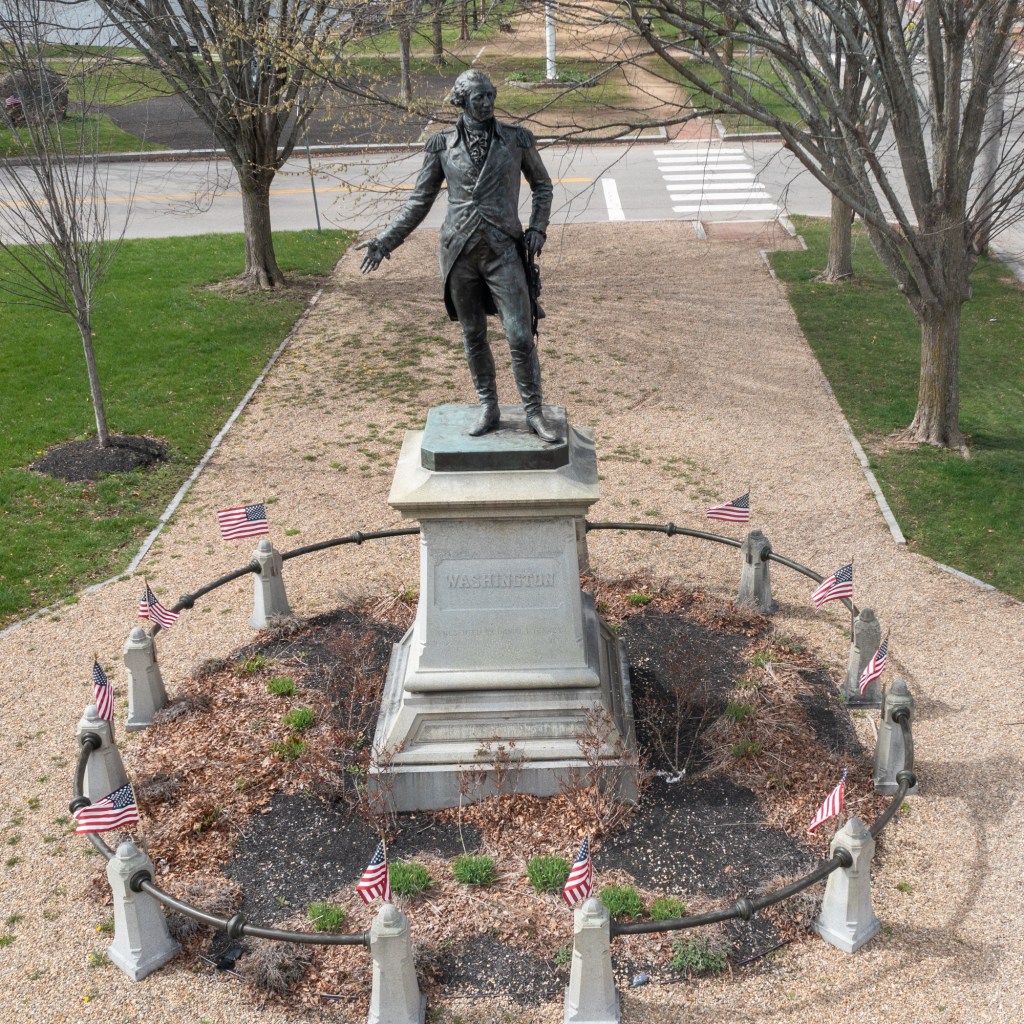
There is a statue at the Bartlett Mall to honor George Washington’s visit, and currently only one sign locally that identifies George Washington’s visit which is located in front of the Dalton House on State St.. No acknowledgment of the President’s visit exists in Amesbury, or Salisbury.
Thanks for reading and supporting local journalism.
“Curious Traveler” is a series of stories written by C.J. Fitzwater. If you’re interested in meeting, sharing a meal, and telling your story, send him an email at cfitzwater@ymail. com.
https://newburyportnews-cnhi.newsmemory.com/?publink=0022fce6c_13520bf

 Curious Traveler
Leave a comment